
About the Unlock the Everyday assistive technology campaign
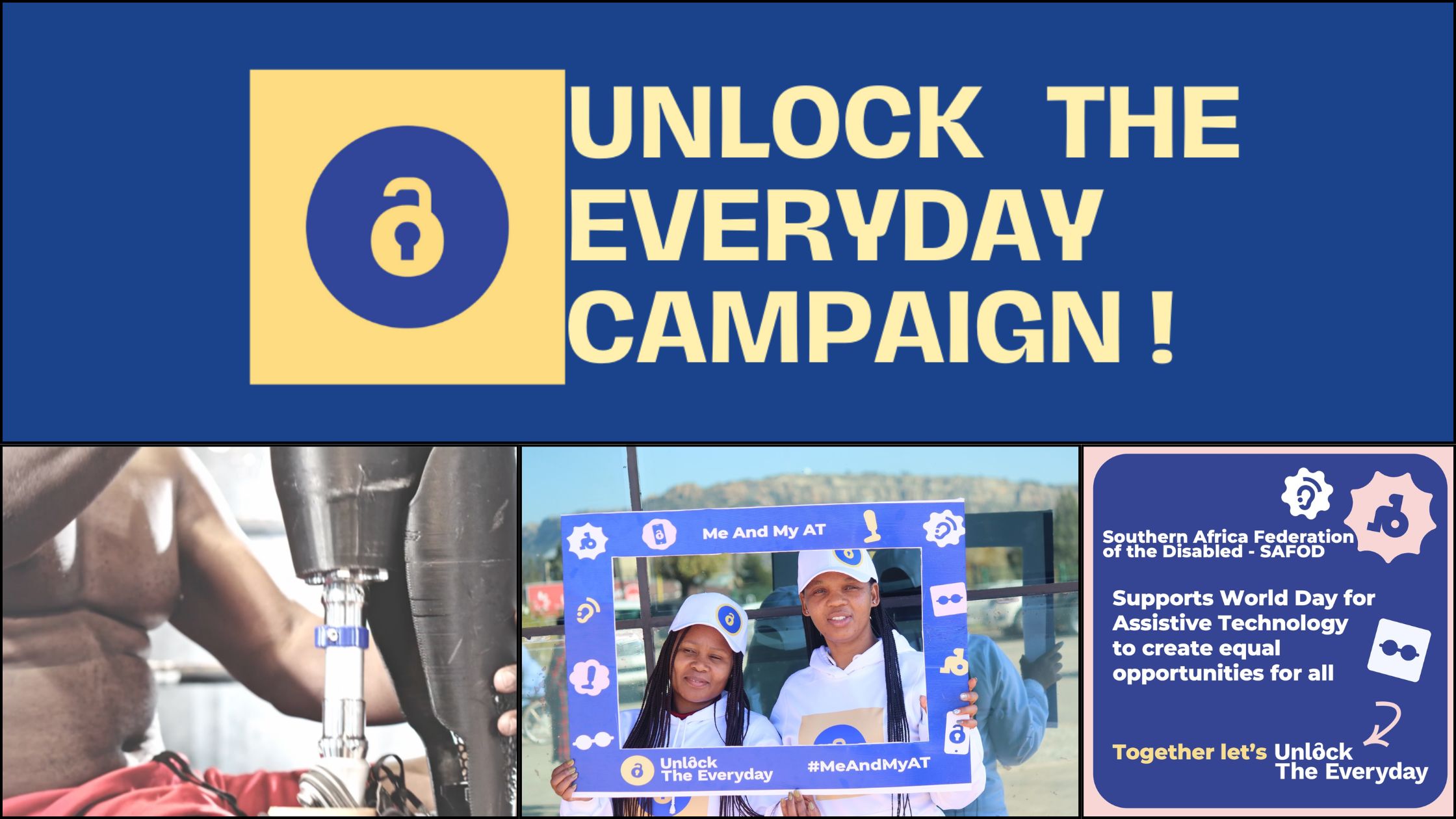
SAFOD runs the Unlock the Everyday assistive technology campaign in Southern Africa. With 10 organisations of persons with disabilities in 8 countries, we push for access to the tools people need.
SAFOD coordinated and delivered the regional World Assistive Technology (AT) Awareness Campaign, working in close partnership with 10 Organisations of Persons with Disabilities (OPDs) across the SADC region. SAFOD provided overall coordination and strategic guidance, while OPDs led on-the-ground activities at national and community levels.
The campaign was delivered across three phases: pre-commemoration, commemoration, and post-commemoration. This ensured broad outreach and lasting impact beyond World Assistive Technology Day. The AT Scale Global Partnership funds the work as part of the global Unlock the Everyday campaign.
Why this assistive technology campaign matters
Across Southern Africa, persons with disabilities face high levels of poverty, unemployment, and exclusion from education and community life. Assistive technology is internationally recognised as a critical enabler of independence, dignity, and participation. It helps learners access education, supports workers to develop skills, and facilitates communication, mobility, and social engagement. The UN Convention on the Rights of Persons with Disabilities recognises the right to assistive technology.
Despite this, AT is not systematically integrated into national health systems or service delivery platforms. Many products are imported and unaffordable. Essential follow-up services — fitting, maintenance, and replacement — are rarely covered by public systems. Awareness among policymakers, service providers, and communities remains critically low. Our assistive technology campaign directly targets these gaps.
Implementing partners
- Botswana Federation of the Disabled (BOFOD)
- University of Botswana Disability Support Services Unit (UB-DSS Unit)
- Federation of Disability Organisations in Malawi (FEDOMA)
- University of Malawi Disability Rights Clinic (UNIMA)
- Federation of Organisations of Disabled People in Zimbabwe (FODPZ)
- Zambia Federation of Disability Organisations (ZAFOD)
- Youth In Action for Disability Inclusion (YADIZ)
- VILOLE Images Production
- Lesotho National Federation of Organisations of Disabled (LNFOD)
- Lesotho National League of the Visually Impaired (LNLVIP)
- Lesotho Council of Non-Governmental Organisations (LCN)
- Disabled People South Africa (DPSA)
- Thisability Newspaper
- Federation of the Disabled in Swaziland (FODSWA)
- National Federation of People with Disabilities in Namibia (NFPDN)
What our assistive technology campaign does
The assistive technology campaign uses a coordinated regional-to-national approach. SAFOD provides strategic oversight and unified messaging, while national OPDs lead high-impact in-country activities. Click each area to learn more.
In each country, OPDs host one collaborative, high-impact engagement designed to influence assistive technology policy and institutional commitment. Formats vary by country:
- Botswana and Lesotho: multi-stakeholder dialogues targeting at least 20 senior government officials, policymakers, human rights institutions, and development partners.
- Malawi: a high-level AT Symposium co-hosted with the University of Malawi's Disability Rights Clinic, bringing together at least 50 participants from government, academia, civil society, and OPDs.
- Zambia and South Africa: stakeholder breakfast meetings convening senior officials from ministries of Health, Education, Finance, and Science and Technology, alongside OPDs and development partners.
All engagements integrate lived experiences of AT users alongside academic expertise and policy perspectives, grounding advocacy in real-world realities.
Integrated into the Botswana multi-stakeholder meeting, the Inclusive AT Wellness Day connects policy dialogue with practical demonstration. At least 20 stakeholders — including OPDs, service providers, AT manufacturers, government officials, and development partners — will showcase products and practical solutions.
Participants gain hands-on exposure to assistive devices through live demonstrations and exhibitions. The event also provides opportunities for basic health and rehabilitation consultations and peer learning, generating practical insights to inform ongoing advocacy by BOFOD.
All 11 partners — SAFOD and 10 national OPDs — will run a coordinated social media campaign throughout the full three-month project period. Using the official campaign toolkit, partners will share stories, videos, and advocacy messages tailored to their national contexts while maintaining unified regional branding.
SAFOD will engage at least three digital content creators with disabilities as regional campaign champions. At least five UN Volunteers will support content creation and mentor national OPDs to strengthen their digital advocacy capacity across Facebook, LinkedIn, X, and YouTube.
SAFOD will host a regional inclusive AT webinar bringing together OPDs, AT users, manufacturers, universities, government representatives, and development partners. The webinar will explore six thematic areas:
- Education and opportunities for young people.
- University-led innovation and local solutions.
- Local manufacturing and prototyping.
- Policy and government engagement.
- Climate change, disasters, and AT resilience.
- Lived experiences of AT users.
SAFOD will document best practices and lessons from both the 2025 and 2026 campaigns and compile them into an accessible, interactive digital flipbook. Designed with inclusive features — screen reader compatibility, descriptive image text, and clear navigation — the flipbook will include country case studies, user stories, and replicable advocacy models.
The flipbook will be launched through a hybrid regional meeting and promoted across SAFOD's social media platforms to extend its reach and impact across Southern Africa.